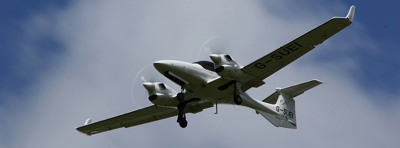
G-SUEV (DA40NG) Notes
(as at November 2025)
Key Contact Information
Sue Bell: 07764 616826
Warwick Benge: 07971 508583
SueAir’s email address contact@sueair.co.uk
SueAir’s website address https://www.sueair.co.uk
Kemble Information: 118.430
Kemble Tower: 01285 771177 (Cotswold Airfield is PPR by phone)
Cotswold airfield Ops email: ops@cotswoldairport.com
Cotswold airfield website: Cotswold Airport | Executive travel, private jets, events, training
Don’t hesitate to contact Sue Bell on 07764 616826 if you have any questions or problems.
Executive Summary
- Know the operating hours for Cotswold airfield and how to operate on indemnity outside the operating hours
- Make sure you have the documents folder and tech log on board (should be in the a/c)
- Let Sue or Warwick know if you notice any tech items
- Check MTOW, max landing weight and MZFW are all within limits
- Do a water sediment check before the first flight of each day
- Minimise the time before you start the engine once the electric master is ON
- Know the fuel consumption and fuel capacity and understand how to use the fuel totalizer
- Do not flat spot the tyres by braking early
- Do not land on grass runways unless approved by Sue Bell
- Put the control lock and pitot cover ON after every flight
Collecting and Leaving G-EV
You will find G-EV on C2 apron to the west of the Control Tower. She will be left with the pitot cover ON, the control lock in place, the nose wheel chocked and the parking brake OFF. The fuel baffle should be removed if the outside air temperature is above 20 degrees Celsius (it is stored in the pocket next to the P1 seat when not in use). The keys are located in the pocket next to the P1 seat.
After your flight, please leave G-EV in the same state as set out above and on the C2 apron. If you have set up your own pilot profile in the G1000 (aux page), please reset this to the DEFAULT profile after your flight.
G-EV is moved out/into the C2 hangar by Ops. The Ops staff work Monday to Friday, therefore if you wish to fly over the weekend you need to let Sue know by 4 pm on Friday so that it can be arranged for G-EV to be left on the C2 apron.
After your flight, please email a photo of the tech log sheet to Sue Bell.
It is possible to land at Cotswold airfield on indemnity when it is closed subject to certain conditions and you need to arrange this in advance. Please contact Warwick Benge or Sue Bell for information about landing on indemnity.
Pre-flight & Post-flight Checks
If you notice any tech items before your flight, please let Sue Bell know.
Carry out an A check before the first flight of the day. This includes:
- Water sediment check. If water enters the fuel injectors or high pressure pump it will cause significant damage and could lead to engine failure. There is a strainer in the storage space behind the pax seats and there are 3 drains to check. In the unlikely event you do find water in the fuel, please let Sue Bell know. Pilots are required to sign off on his check before every flight because it is so vital.
- Check the wing tip lights and landing & taxi lights
- Check the pitot heat is working (only turn ON for a few seconds or it will overheat)
- Check the stall warner horn is working
- Check the oil (see section below)
- Check the fuel state (see section below)
- Check the airframe & propeller
- Check the tech log & aircraft documents
Carry out W&B calculations. A spreadsheet to enable you to do weight and balance calculations more easily can be found on the Aircraft page of SueAir’s website. It is vital you check the MTOW, the maximum landing weight and the maximum zero fuel weight. All three of these weights must be in limits before take-off and before landing at your destination.
Electric Rudder Pedals
If you need to turn ON the electric master switch to move the rudder pedals after your flight to put the control lock in place, please remember to turn the electric master switch OFF again or you will flatten the main battery!
Oil
You are responsible for checking the oil level and topping it up, if necessary (i.e. Cotswold airfield or SueAir do not provide this service). Spare oil and cardboard funnels are kept behind the pax seats in the storage space underneath the floor. In the unlikely event there is no oil here, spare oil is kept on a shelf in the hangar. Only ever put in 0.5 litre (i.e. half a container) in an engine as this amount of oil will take the level from the bottom to the top.
Fuel
G-EV will be left with full main tanks (28 USG) in the absence of a special request. However, please do check the fuel state as it is not always possible to arrange fuel. Should you wish to depart with less than full mains, when you request a booking through the on-line booking schedule, please put a note in the "Special requests" field to say how much fuel you would like in the mains and I will arrange this. If you need to arrange your own refuelling at Cotswold airfield , contact Kemble Ops and the uplift will be put on my account. If you do not depart with full mains, please treat any figure entered into the tech log or fuel totaliser with caution and in this scenario looking at the fuel gauges (which are accurate) gives you the best indication of the fuel state.
G-EV has extended range tanks (39 USG). It is recommended that G-EV is only refuelled to full mains (28 USG) unless you are going on a long trip. Please see this note for help with calculating the fuel uplift required to top up the fuel tanks back to full mains.
As mentioned above, it is very important to check the fuel for water contamination prior to the first flight of each day. If water enters the high pressure pump it will cause significant damage and lead to engine failure. Water also damages the fuel injectors. There is a strainer in the storage space behind the pax seats and there are 3 drains to check. In the unlikely event you do find water in the fuel, please let Sue Bell know.
If you collect G-EV with full mains, remember to use the fuel totalizer to record the fuel on board in the G1000 by pressing the “INC fuel” soft key (ENGINE, FUEL soft keys) and you will then know very accurately the amount of fuel on board at every stage of your flight.
If you are away on a trip for a few days, there is a BP card in the flight bag (flap at the front), which you are welcome to use and fuel purchased will be invoiced to me. Should you need to buy fuel (e.g. at an airfield that does not accept a fuel card), I will either net the amount off your invoice (up to a maximum limit – see next paragraph) or put a credit on your account that can be used to purchase further hours (if you decide to buy a block of hours) or refund the amount to your bank account.
I meet the cost of fuel purchased by a pilot on a trip up to a maximum amount per hour calculated as follows:
(Cotswold airfield’s fuel price before VAT x 25 + £5.50) + VAT@20%
I record fuel state on the Tech Log in USG. When the extended tanks have been filled, please put 39 USG in the tech log. When the main tanks only have been filled, please put 28 USG in the tech log. If you are not able to rely on the fuel figure in the fuel page of the G1000 (either because you forgot to press the "RESET FUEL" soft key before your flight or you departed with less than full mains and you think that you cannot rely on the figure in the G1000) assume a fuel consumption of 6.5 USG per hour when calculating the fuel used for your flight.
RT & circuit procedures at Cotswold airfield
A few points to note about operating from/to Cotswold airfield:
- Initial radio call is: "Kemble Information, G-SUEV, request radio check" (We think this is just so they have time to write the strip!). Kemble FISO will respond with "Readability X, pass your message" (or sometimes non-standard "pass your details")
- First call should be made when actually ready to taxi (minus setting the QNH), as Kemble FISO will always give taxi instructions as the final part of their message, which is for the traffic situation at that moment (so set up avionics etc prior to first contact)
- Overhead joins are preferred, direct joins are also acceptable subject to traffic, but only in the normal circuit direction. LH R26, RH R08. Kemble FISO will make it clear if they do not think a direct join is a good idea, but they cannot issue a direct instruction, so heed their tone and messaging.
Avoid using orbits for spacing as Kemble FISO do not have active control of the circuit traffic.
Post Flight Actions
If you notice any tech items either after your flight, please let Sue Bell or Warwick Benge know on the day. Do NOT leave it for the next pilot to find.
After each flight:
- Fill in the tech log, take a photo and email this to Sue Bell.
- Put the control lock ON (see below for details of how to do this)
- Put the pitot cover ON (after the pitot tube has cooled down)
- Chock the nose wheel
- Put the keys in the pocket next to the P1 seat
- During summer months, clean the canopy so that it is clean for the next pilot (windscreen cleaner and a soft cloth are located in the storage area under the floor behind the pax seats)
- Return borrowed headsets, life jackets and life raft to the cupboard in the hangar
How to put the Control Lock ON
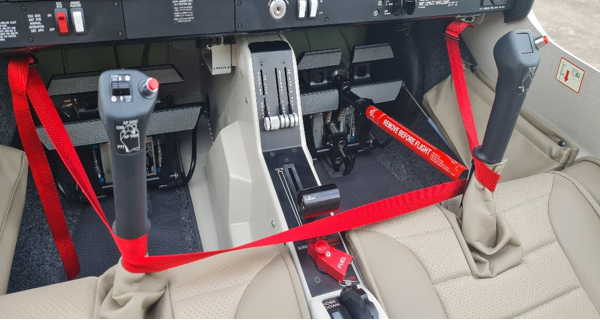
The rudder is large and will get damaged even in relatively light winds if the control lock is not in place when G-EV is parked. The straps have been left at the correct length assuming the rudder pedals are in the most rearward position (i.e. the position for a shorter pilot) and that the control lock is put onto the base of the control stick - please don't change the length of the straps at it is very fiddly to change them again. If you think the straps are the wrong length it is more likely that you have not moved the rudder pedals to the most rearward position! See section above on how to move the rudder pedals.
The photo below shows how the control lock should look when it has been correctly fitted.
Checklist, AFM and aircraft documents
A current checklist can be found in the front LH pocket of the aircraft. If this has been misplaced, please let Sue Bell or Warwick Benge know. There is a soft copy of the checklist within the G1000 and also, a link to a checklist can be found on the Aircraft page of SueAir’s website.
The aircraft’s flight manual (AFM) is located in the blue flight bag behind the pax seats. Please do NOT remove this from the aircraft. A link to the AFM can be found on the Aircraft page of SueAir’s website.
All the aircraft’s documents and the tech log are kept in the a/c. Please make sure you have this folder on board before departure. Please do NOT remove any documents. Contact Sue Bell or Warwick Benge if you need soft copies of any documents. The AFM is located in a blue flight bag behind the rear pax seats.
Cruising Power
Please fly in the cruise at a power setting of 70% to 75% (ideally 70%). A cruise setting of 70% helps to minimize engineering costs and will give you a better range.
Brakes
DA40s have relatively small wheels. As well as making it difficult on grass one of the other issues with small wheels is that it is easy to lock the wheels on braking after landing. The problem then is that this permanently 'flat spots' the tyres, so they bump down the taxi way and need replacing pretty soon afterwards. Unfortunately, I have now had to replace the tyres on my planes several times owing to flat spotting (usually just after the tyre has been replaced), and therefore need to ask all pilots please to take care not to apply the brakes until the aircraft has slowed down considerably after landing. This means ensuring your heels are on the floor and your toes are pointing slightly outwards on finals and on the initial ground run. Assuming the runway is clear and you land on the numbers (all SueAir pilots do!) then there should be lots of room to allow natural slowing first.
Obviously if there is an emergency, then saving the flat spotting of the tyres is not a priority.
Payment of Duty on Jet A1 for Private Pleasure Flying
There is a legal requirement binding on pilots flying aircraft using Jet A1 to pay excise duty to HM Revenue & Customs (HMRC) for fuel used during any 'private pleasure flight'.
There is a note on the Hire Rates page that gives further detail on this subject. In basic summary, if you fly within the UK for private pleasure (as opposed to e.g. training - see the detail in the note regarding exclusions) a pilot has to account within 30 days to HMRC for duty on the fuel used. This is a personal legal obligation on the pilot.
Because this increases the cost to pilots of certain flights, SueAir will offset that cost in part as provided in the note.
Control Lock, Tie Downs & Yellow Baffle
Always put the control lock in place after your flight. The rudder is relatively large and will become damaged if the control lock is not in place when G-EV is parked. Details of how to do this are set out above.
Tie downs are located in the storage space behind the pax seats (i.e. same location as the oil & canopy cleaner). Please use these if you are away from Cotswold airfield over-night and strong winds are forecast.
There is a yellow baffle under the right hand wing that should be removed prior to your flight when the outside air temperature is above 20 degrees Celsius. If you do remove it, I suggest storing it in the pocket by the P1 seat (where the keys are kept) whilst you are flying. Please put it back under the wing after your flight.
Tow Bar
If you need to manoeuvre G-EV on the ground prior to starting the engine, there is a tow bar behind the pax seats.
Canopy Cleaner & G1000 Screens
A can of Plexiglas to clean the canopy, together with a soft cloth, can be found behind the pax seats under the floor (where the oil is kept). I clean the screen regularly but in the summer when there are lots of flies please clean the screen after your flight so that it is clean for the next pilot.
Please do NOT try to clean the G1000 screens. I have special antistatic cleaner and a very soft cloth that I use on the screens. Also, please do not touch the screens when you are flying.
Please do NOT put headsets or PLOGs on top of the G1000 screens as this will lead to the canopy being scratched.
Grass Runways
SueAir's aircraft are not suitable for grass runways. In the summer sometimes it can be OK, but the risk in winter is too much. If you do want to visit a grass airfield, please ask for Sue Bell’s approval first.
Life Jackets, Life Raft and Headsets
Life jackets are available for hire from SueAir at a cost of £1.25 + VAT per jacket for the first 2 days and £0.90 + VAT per jacket for each additional day.
A 4 man life raft is available for hire from SueAir at a cost of £12.50 + VAT for the first 2 days and £9.00 + VAT for each additional day.
Spare headsets are located in the cupboard in the hangar.
If you would like to hire life jackets or the life raft or borrow a headset, please put a note in the "Special requests" field of the on-line booking form.
|